When Silence Breaks: Sitting With Job in His Darkest Despair (Job 3)

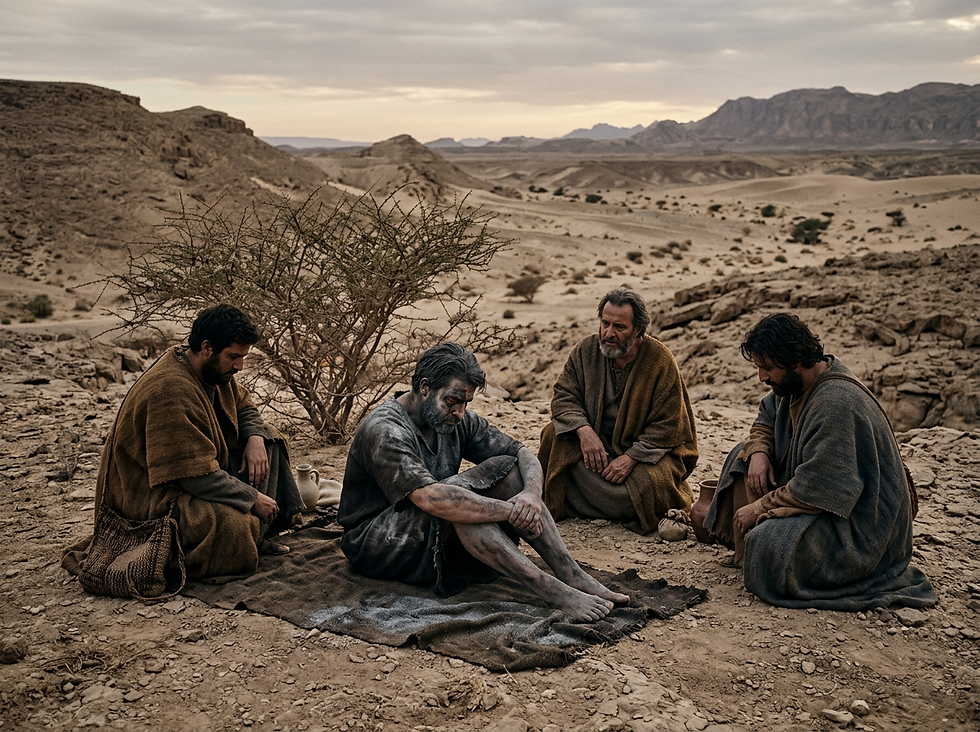
For many who have faced deep loss or wrestled with doubt, the story of Job offers a rare and honest glimpse into human suffering. The opening chapters of Job describe a man stripped of everything—his children, his wealth, his health—and left in a state of unimaginable torment and grief. Yet, before Job speaks, there is a profound silence. His friends sit with him for seven days without saying a word, overwhelmed by his suffering. This silence is not empty; it is full of presence and empathy.
For seven days, nobody said a word.
That's easy to skip past, but it's worth sitting with like his freinds did. Job's three friends — Eliphaz, Bildad, and Zophar — heard what had happened to him: his children gone, his wealth gone, his body covered in sores, his wife telling him to "curse God and die" (Job 2:9, NLT). When they finally arrived and saw him, they barely recognize him. So they tore their robes, wept, and sat down on the ground beside him for a full week without speaking, "for they saw that his suffering was too great for words" (Job 2:13, NLT).
I can imagine that scene clearly — three men lowering themselves into the ashes next to their ruined friend, having absolutely nothing to say, and choosing to stay anyway. It's one of the most honest pictures of presence in the whole Bible. Sometimes love doesn't have a script.
Then Job breaks the silence in chapter 3, and what he says is raw, unfiltered, and deeply human. His words reveal the anger, doubt, and grief that many Christians struggle to express. This post explores that moment when silence breaks and what we can learn from Job’s dark despair.

A Man Who Wants to Disappear
"At last Job spoke, and he cursed the day of his birth" (Job 3:1, NLT).
What follows isn't a tidy prayer or a theological argument. It's raw.
"Let the day of my birth be erased, and the night I was conceived. Let that day be turned to darkness. Let it be lost even to God on high, and let no light shine on it" (Job 3:3–4, NLT).
He keeps going — wishing the night of his conception had never been counted on a calendar, wishing it had been childless and joyless, wishing the day itself could be cursed out of existence (Job 3:5–8, NLT). Then he says the part that we all can resonate with:
"Why wasn't I born dead? Why didn't I die as I came from the womb?" (Job 3:11, NLT).
Later in the chapter he adds, "Oh, why give light to those in misery, and life to those who are bitter? They long for death, and it won't come... They're filled with joy when they finally die, and rejoice when they find the grave" (Job 3:20–22, NLT).
If you've ever sat with someone in a crisis, or been the one in crisis yourself, you know this language. This is a man who wants out. Not necessarily out of life in some active, immediate sense — but out of the pain, out of the weight, out of a world that no longer makes sense.
Job isn't making a doctrinal statement here. He's a father who buried all ten of his children in one day, and his body hurts, and he cannot see a reason to keep going. If we're honest, that sounds like grief. It sounds like trauma. If a friend spoke these words to us today, we would take them seriously as a warning sign, not wave them off as poetry.
The silence sets the stage for Job’s outburst. It shows that before anger and doubt come, there is a space where grief is held without judgment.
Why Is This Happening?
Underneath the pain and trauma is one question, asked over and over in different forms: why.
Why was I born. Why didn't I die at birth. Why is life given to someone in my condition. It's the same question so many of us ask when the ground gives way beneath us — why this diagnosis, why this loss, why this year, why does the world feel like it's coming apart.
Job doesn't get an answer to "why" anywhere in this chapter, and honestly, he doesn't get a clean answer to it anywhere in the whole book. That's part of what makes Job so strangely comforting. Scripture doesn't rush him — or us — past the question.
These feelings and the questioning are difficult for many Christians to admit. The expectation often is to respond to suffering with faith and hope. Yet Job’s honesty shows that doubt and anger are part of the journey.

Remembering Where He Stands
It helps to remember what Job is actually working with in this moment. Two verses earlier in the story, his wife had reduced his options to exactly two: "curse God and die" or keep holding on to his integrity (Job 2:9–10, NLT). That's it. That's the whole menu grief has handed him.
He is not thinking clearly — how could he be? He has lost nearly everyone he loves, his health has collapsed, and his wife, likely also drowning in her own unspeakable grief, has all but told him to give up. Yet, even as Job 3 shows us a man in the pit of despair, he never actually curses God. He curses the day. He curses the night. He curses his own existence. But God remains, even here, someone Job is still in relationship with rather than someone he has walked away from.
This distinction matters. Despair and faith are not always opposites sitting on either side of a wall. Sometimes they're in the same room, the same sentence, the same prayer. Job shows us that it's possible to be honestly, desperately undone and still be — however faintly — oriented toward God rather than away from Him.
Job’s speech in chapter 3 is a rare biblical example of someone openly expressing despair and doubt toward God. This challenges common assumptions about faith and suffering:
Despair is a natural response: Feeling despari in the face of loss does not mean a lack of faith. It is a human reaction to pain.
Doubt can coexist with belief: Job’s doubts do not erase his faith. They show a complex relationship with God that includes questioning.
Honesty is healing: Speaking honestly about pain can be a step toward healing. Job’s words give permission to express what is often hidden.
For those who have suffered loss, these lessons are vital. They remind us that faith does not require pretending everything is fine. Instead, it allows space for real emotions.
Sitting with Job Today
Maybe you've never spoken words as dark as Job's out loud. Maybe you have. Either way, Job 3 gives us permission to bring our real questions and our real despair into the light rather than dressing them up for church. It also gives us a model in those three friends: before anyone offers advice, before anyone tries to fix or explain, someone simply sits down in the ashes and stays.
If you're the one in the ashes right now, you're in good company — Job's, and countless others who have asked "why" and not received an answer, only a presence. If you're the one who doesn't know what to say to a friend in pain, Job 2 already told you what to do. Sit down. Don't rush the silence. The words, when they come, will come.

Final Thoughts
Job’s silence and his dark words in chapter 3 reveal the complexity of human suffering. They show that loss brings despair and doubt, and that these emotions are part of a faithful life. The story encourages us to sit with pain, to listen without rushing to fix, and to speak honestly when the silence breaks.
If you are facing loss or doubt, remember that your feelings are part of the journey. You do not have to hide your anger or pretend to have all the answers. Like Job, you can bring your deepest questions and pain into the light. And like his friends, those who love you can offer their presence, even when words fail.
Take a moment today to sit with your own silence or the silence of someone you care about. Sometimes, that quiet presence speaks louder than anything else.
Blessings,
Stacey
Disclaimer: This post is for informational and spiritual reflection only. It does not replace professional counselling or medical advice. If you or someone you know is struggling with thoughts of suicide or self-harm, please reach out to a counsellor, pastor, or a crisis line in your area. You don't have to carry it alone.


Comments