Job 10: When Pain Tells You Who God Is

Have you ever caught yourself thinking, "God is just messing with me"?
Maybe you never said it out loud. Maybe it came as a quiet suspicion after one more bad report, one more loss, one more door closing. If so, you are in good company. Job thought it too, and in chapter 10 he says it out loud to God's face.
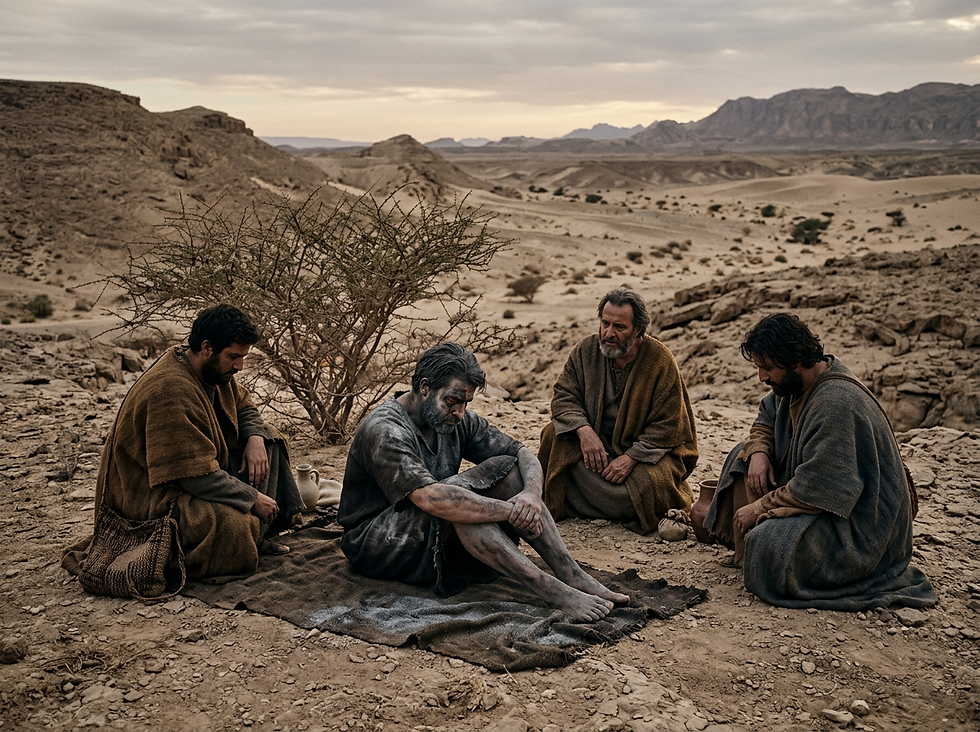
Recently I sat with a friend who has lost almost everything that held his life together: someone he loved deeply, his home, and the stability he had always counted on. As he talked, I heard Job in chapter 10. The grief was so heavy that it was starting to color everything, even how he saw God. I also felt the frustration Job's friends must have felt. How do you help someone carrying that much pain and loss?

Honest pain is allowed
Job opens with brutal honesty:
“I am disgusted with my life.” Job 10:1, NLT
Job decides to complain freely and asks God not simply to condemn him, but to tell him the charge (v. 2). Then he questions God's motives. What does God gain by crushing the work of His own hands while the plans of the wicked seem to prosper (v. 3)? Does God see the way people see, rushing to dig up some hidden fault (vv. 4–6)?
Before we rush to correct Job, notice something. He is talking to God, not just about God. His friends spend chapter after chapter explaining God. Job keeps bringing his pain directly to Him. At the end of the book, God says the friends did not speak accurately about Him, as His servant Job did (42:7). God is not threatened by our honest pain. Lament is a form of faith.
A Memory of Love
Then Job remembers. He pictures God as a potter shaping clay (vv. 8–9). He describes God forming him in his mother's womb (v. 10), clothing him with skin and flesh, and knitting his bones and sinews together (v. 11). Then comes the high point of the chapter:
“You gave me life and showed me your unfailing love.” Job 10:12, NLT
"Unfailing love" translates the Hebrew word hesed, God's loyal, covenant-keeping love. Job adds that God's care preserved his life. In the darkest chapter of his life, Job remembers something true. God made him, loved him, and kept him.

The Turn
But Job doesn't stay there. In the very next breath, he suggests that God's real motive all along was to watch him and catch him in sin (vv. 13–14). In Hebrew, the word behind "preserved" in verse 12 and "watch" in verse 14 is the same verb. It means to keep or guard. In verse 12, God's watchful care protects Job. In verse 14, Job reinterprets that same care as surveillance. By verse 16, he pictures God hunting him like a lion.
This is the temptation of chapter 10. It isn't grief, tears, or honest questions. The temptation is letting pain rewrite the past, until even God's kindness looks like a setup. When we are in despair, it is easy to turn inward and feel sorry for ourselves. From there, it is a short step to deciding that God has it out for us.
At the beginning of the story, Scripture says, "In all of this, Job did not sin by blaming God" (1:22). In chapter 10, Job is drifting toward that edge. Later, God names this exact danger when He asks Job whether he will condemn God just to prove himself right (40:8).
A Dark View of Death
Job ends the chapter back where he began in chapter 3, asking why he was ever born. He begs God to leave him alone for a little comfort before he goes to a land of gloom, where even the light is like darkness (vv. 21–22).
Part of what makes Job's despair so heavy is that his view of death is so dim. Like many Old Testament believers, he pictured the grave as a shadowy place without joy. We stand in fuller light. Paul writes that Christ Jesus "broke the power of death" and lit the way to life and immortality through the Good News (2 Timothy 1:10). Job couldn't yet see what we have been shown.

Let Love Interpret Your Pain
Chapter 10 leaves us with a question. When present suffering seems to contradict your past experience of God's love, which one gets to interpret the other? Job let his pain interpret God's love. The gospel invites us to do the opposite. God "did not spare even his own Son" for us (Romans 8:32), and Paul is convinced that "nothing can ever separate us from God's love" (Romans 8:38).
It is okay to tell God how much it hurts. The danger is letting the hurt tell you who God is.
If you are in your own chapter 10 right now:
Say it to God. Bring Him the complaint instead of carrying it alone.
Remember your verse 12. Write down specific ways God has given you life and shown you His love.
Let someone sit with you. Despair grows in isolation.
If you are sitting beside someone else's chapter 10, you don't need answers. Job's friends did their best work at the start, when they sat with him in silence because they saw his suffering was too great for words (2:13). With my friend, I could not fix anything. I could honor his losses, remind him of the people still standing with him, and gently point him to the God whose love has not failed him.
Sometimes that is the help.
Blessings,
Stacey



Comments