When a Father Finally Says theTruth: Genesis 49

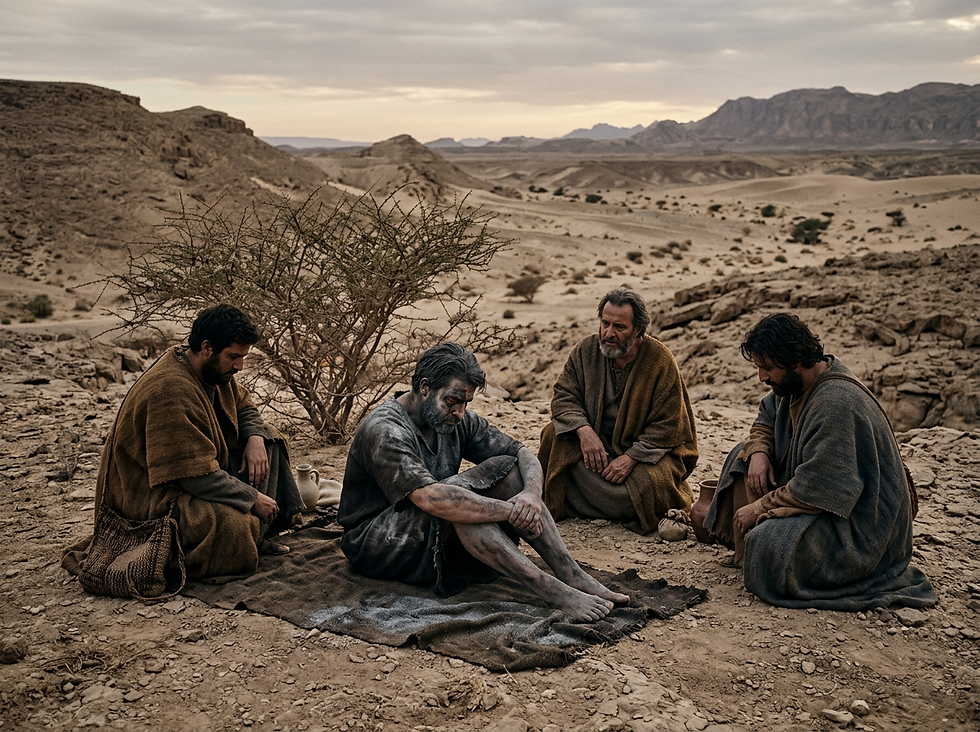
There's a particular kind of ache in waiting your whole life to hear your father name who you really are. Genesis 49 is that moment — except it happens only at the very end, with Jacob on his deathbed, gathering all twelve sons around him for the first and last time to say, out loud, what he has apparently thought about each of them for years.
"Gather yourselves together, that I may tell you what shall befall you in the last days" (Genesis 49:1). What follows is not a vague fatherly pep talk. It is a series of pointed, specific, prophetic assessments — and Jacob does not soften them for comfort's sake.

Reuben, the firstborn, is told plainly: "Unstable as water, you shall not have preeminence, because you went up to your father's bed" (49:3-4). That's not poetic flourish. That's Jacob naming, decades later, what Reuben did in Genesis 35 — and letting the consequence finally land. Simeon and Levi are named together: "instruments of cruelty are in their dwellings... cursed be their anger, for it was fierce" (49:5-7), a direct callback to the massacre at Shechem in Genesis 34. Jacob had said nothing at the time. Now, at the end, he says everything.
This is what mature accountability looks like: not reacting in the heat of the moment, but also not letting the moment simply disappear into silence. Jacob's blessing is really a life review — each son measured against what he actually did, not what everyone politely pretended not to notice.
Levi does not remain under the same fate as Simeon. In Genesis 49:7, Jacob curses them together — "I will divide them in Jacob and scatter them in Israel" — but their tribes diverge sharply. Simeon's tribe is eventually absorbed into Judah's territory and effectively disappears from Israel's history. Levi's "scattering," however, is repurposed rather than simply endured: later in the Torah, the Levites become the priestly tribe, deliberately scattered among all the other tribes to serve rather than left landless as a punishment. So the same curse produces two very different outcomes — one tribe fades out, the other is given a different kind of purpose. Any claim that Genesis 49 shows consequences following the brothers uniformly into the future should note Levi as the exception, not the confirmation.
And then the tone shifts. Judah, despite his own considerable failures in chapter 38, receives the promise that the scepter will not depart from him until tribute comes to him (49:8-10) — the line that leads, ultimately, to the Messiah. Grace doesn't erase the accounting; it runs alongside it.
Reuben, the firstborn, is told plainly: "Unstable as water, you shall not have preeminence, because you went up to your father’s bed" (49:3-4). That’s not poetic flourish. That’s Jacob naming, decades later, what Reuben did in Genesis 35 — and letting the consequence finally land.
This is what mature accountability looks like: not reacting in the heat of the moment, but also not letting the moment simply disappear into silence. Jacob's blessing is really a life review — each son measured against what he actually did, not what everyone politely pretended not to notice.
Levi does not remain under the same fate as Simeon. In Genesis 49:7, Jacob curses them together — "I will divide them in Jacob and scatter them in Israel" — but their tribes diverge sharply. Simeon's tribe is eventually absorbed into Judah's territory and effectively disappears from Israel's history. Levi's "scattering," however, is repurposed rather than simply endured: later in the Torah, the Levites become the priestly tribe, deliberately scattered among all the other tribes to serve rather than left landless as a punishment. So the same curse produces two very different outcomes — one tribe fades out, the other is given a different kind of purpose. Any claim that Genesis 49 shows consequences following the brothers uniformly into the future should note Levi as the exception, not the confirmation.
And then the tone shifts. Judah, despite his own considerable failures in chapter 38, receives the promise that the scepter will not depart from him until tribute comes to him (49:8-10) — the line that leads, ultimately, to the Messiah. Grace doesn't erase the accounting; it runs alongside it.
Joseph: naming the wound and the strength in the same breath
Then comes Joseph, and the blessing changes altogether. It's the longest of the twelve, and the richest: "Joseph is a fruitful bough, a fruitful bough by a spring; his branches run over the wall. The archers bitterly attacked him, shot at him, and harassed him severely, yet his bow remained unmoved; his arms were made agile by the hands of the Mighty One of Jacob... blessings of heaven above, blessings of the deep that lies beneath... may they be on the head of Joseph, on the brow of him who was set apart from his brothers" (49:22-26).
Notice what Jacob does here. He does not minimize what happened to Joseph — sold by his own brothers, lied about, imprisoned on false charges, forgotten in a foreign prison for years. "The archers bitterly attacked him" is Jacob finally acknowledging real harm, out loud, to the son who lived it. But he doesn't stop at naming the wound. In the same sentence he names the strength that came through it: the steady bow, the agile arms, the hand of God underneath it all. He blesses both the suffering and the character forged by surviving it.
That's a pattern worth sitting with personally. If you're a parent, a mentor, a friend — sometimes the most loving thing you can say to someone isn't "you're fine" or only "look how strong you are." It's both: I see what was done to you, and I see who you became anyway. Silence about the wound doesn't protect someone. Naming it, and naming their strength in the same breath, does.
Benjamin: the son named twice
Benjamin's blessing, by contrast, is a single verse — short, almost fierce: "Benjamin is a ravenous wolf; in the morning he devours the prey, and at evening he divides the spoil" (49:27). No mention of suffering here. Just strength, appetite, and victory.
But Benjamin's whole story is already a story of naming. He was born as his mother Rachel was dying, and with her last breath she named him Ben-oni — "son of my sorrow" (35:18). Jacob, in that same verse, renamed him Benjamin — "son of my right hand." Jacob had already, decades earlier, refused to let his youngest son's identity be permanently defined by the grief surrounding his birth. The blessing in chapter 49 is consistent with that first act of naming: not a son of sorrow, but a son of strength.
Applying Jacob's Message Today
Jacob's blessings offer practical insights for anyone interested in family dynamics and personal growth: speaking truth with care, so honest feedback helps people grow without being delivered as cruelty; recognizing individual strengths and weaknesses, since each person has a unique role that contributes to the whole; embracing accountability, since taking responsibility for actions strengthens relationships and builds trust; valuing forgiveness and reconciliation, as Joseph's story shows overcoming past hurts can lead to healing and unity; and considering the long-term impact of words, since what we say shapes future generations.

Conclusion:
Jacob's final blessings in Genesis 49 are a powerful reminder that family relationships carry deep responsibility. His words hold his sons accountable while offering hope and guidance. Reuben, Simeon, Levi, Judah, Joseph, and Benjamin each receive a distinct reckoning — not a uniform judgment, but one calibrated to what each of them actually did and became. Reflecting on this chapter invites us to consider how we shape our own family stories. By speaking truth, embracing accountability, and fostering forgiveness, we can build legacies that honor both our past and future. Jacob's blessings challenge us to live with intention, knowing that our actions echo through generations.



Comments