Among the Ashes: Reflections on Job 2

Last week we sat with Job in his sudden and staggering loss — everything stripped away in a single chapter. This week, we go deeper. Job 2 doesn't offer relief. It offers another wave. And in it, we find some of the most searching questions in all of Scripture: questions about integrity, about the nature of real faith, and about what it looks like to sit with someone in their pain instead of rushing them out of it.
Where Have You Come From?
The chapter opens with a scene we've seen before — the sons of God presenting themselves before the Lord, and Satan among them. God asks him the same question as before: "Where have you come from?" (Job 2:2).
At first glance, it almost sounds like God is caught off guard, as if He's surprised Satan showed up. But that's not what's happening here. This isn't a question born of ignorance. It's more like a parent who already knows exactly what their teenager has been doing and asks anyway — not to gather information, but to expose it. What have you been up to? What are you really doing out there?
Satan's answer sounds almost casual: "I have been patrolling the earth, watching everything that's going on." On the surface, it's vague, even innocent. But sit with the picture a little longer and you'll see it for what it is. This isn't someone taking a walk. This is a prowler. A thief casing a neighborhood at night, looking for an unlocked door, an unguarded life, a weak point to exploit. Satan's "roaming" is predatory. He isn't wandering — he's hunting.
That should give us pause. The accuser is still roaming, still looking for the cracks in our lives where doubt or fear can get a foothold. Job 2 reminds us we're never as unwatched as we think — but neither are we ever outside of God's sovereign permission.

Skin for Skin: The Challenge to Integrity
In verse 4, we come to the accusation that gives this chapter its edge. God points to Job's unwavering integrity even after catastrophic loss. And Satan, unimpressed, fires back: "Skin for skin! A man will give up everything he has to save his life. But reach out and take his health, and he will surely curse you to your face."
Satan's theology is simple and cynical: people are only faithful to God because of what they get out of it. Take away the blessings — especially health, the most personal and immediate of blessings — and the mask will fall off. Underneath, he assumes, is a transactional faith, not a real one.
Here's the uncomfortable part: Satan isn't entirely wrong about some people. There is a strain of faith that only shows up when life is good — a "health and wealth" belief that quietly assumes God owes us comfort in exchange for our devotion. Job 2 forces the question: is my faith built on what God gives me, or on who God is? That's not a question we answer in the abstract. It's answered in the ashes.
Sitting in the Ashes
And that brings us to the verses I want us to slow down on — verses 7 and 8, and then verse 9 right alongside them.
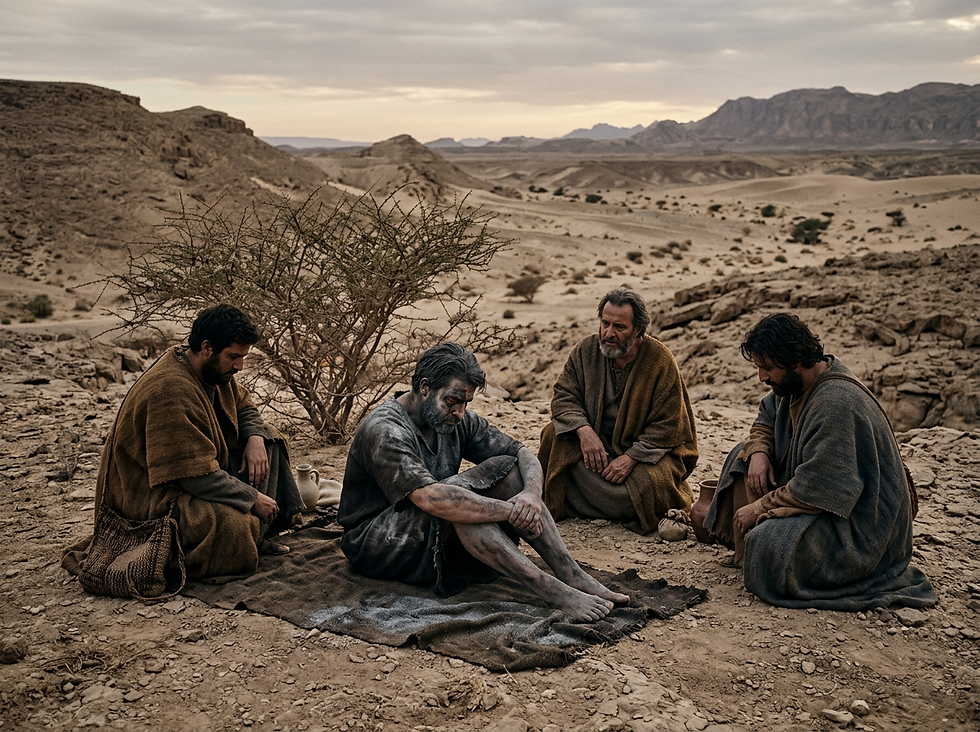
Job is struck with painful sores from head to foot. He takes a piece of broken pottery to scrape his skin, and he sits down among the ashes of his home.
Picture it. Not a metaphor — an actual man, in actual physical agony, surrounded by the wreckage of everything he owned and everyone he loved, scraping his own skin because there is nothing else he can do. No answers. No explanation. Just ash, and pain, and silence.
Have you ever been there? Not literally in ashes, but in that place — where the loss is so total and the pain so present that all you can do is sit in it?
Where words don't come, and the only thing you can offer God is your presence in the wreckage? Job 2 doesn't rush past this moment, and neither should we. Before there's theology, before there's resolution, there is simply a man sitting in ashes. Scripture lets him stay there. It doesn't hurry him to a lesson.

The Wrong Voice, and the Right Ones
Into that silence comes a voice — and it's the voice you'd least expect to wound him further. His wife, the one person who should be beside him in his suffering, says instead, "Are you still trying to maintain your integrity? Curse God and die!"
It's a hard verse to read. Whatever grief was behind her words, the effect was corrosive — pouring accusation onto an already devastated man. It's a sober reminder that even those closest to us, in their own pain, can become instruments of discouragement rather than comfort. Worth asking ourselves: in someone else's ashes, which voice am I bringing?
Thankfully, the chapter doesn't end there. Three friends — Eliphaz, Bildad, and Zophar — hear about Job's suffering and set out, according to verse 11, "to comfort and console him." Whatever we come to think of their later speeches, their initial instinct was right. They came. They showed up.
When they arrived, they almost didn't recognize him — grief had changed his very appearance. So what did they do? They sat with him, seven days and seven nights, in silence, "because they saw that his suffereing was too great for words." (v. 13).
Sitting With, Not Fixing
If there's one thing to carry out of Job 2 this week, it might be this: before we try to explain someone's suffering, we are called to simply sit with them. Job's friends got that part right before they got so much else wrong.
Maybe this week you're the one in the ashes — stripped down, unrecognizable even to yourself, wondering whether your faith can survive contact with real pain. Or maybe you're being called to sit beside someone else's fire, resisting the urge to fix, explain, or rush them forward.
Either way, Job 2 invites us to stay in the hard place a little longer than feels comfortable — trusting that God is present in the ashes, and that faith which survives loss is a faith worth having.
Holding Faith in the Midst of Ashes: A Reflection
Job’s journey is not just ancient history. It speaks directly to anyone who has faced loss, illness, or deep disappointment. His story invites us to explore what it means to keep faith when life feels like ashes.
We see that integrity is not about perfection or quick recovery. It’s about staying real with God and ourselves, even when questions and doubts arise. It’s about refusing to let suffering define us or push us away from our faith in Him.
For those supporting others in pain, Job’s friends remind us that sometimes the greatest gift is simply to be there. To listen. To hold space for grief without rushing to fix it.

As we reflect on Job 2, we are invited to sit with the hard questions about faith and suffering. We are reminded that integrity and real faith often look like endurance, honesty, and presence. In the ashes of loss, faith can still burn bright, not because pain disappears, but because trust holds firm.
If you or someone you know is walking through a season of suffering, take a moment to sit with that pain. Allow space for questions. Remember that faith is not about having all the answers but about holding on when answers are hard to find. And if you are supporting someone in pain, offer your presence first. Sometimes, that is the greatest act of faith and love.
See you on the other side,
Stacey


Comments